Useful WCM iFix – NullPointerException in CmpntUtils.setSourceIDAndName
If you happen to try and import a WCM library and have it fail, then later find that some HTML components trigger errors in the WCM interface when you try to view or edit them – you need iFix 6.0.1.3-WCM-PK60048.
Table Alignment
One of the great challenges of writing an HTML editor is discovering and smoothing over all the weird complexities in HTML. There are just some areas of HTML (and CSS) that are brain-dead stupid and you have to wonder how on earth it ever came to be like that. I suspect most of those brain-dead areas are involved with alignment or tables. This of course means that aligning tables is particularly stupid.
NewsGator Craziness
Why is it that Tim Bray’s perfectly correct Atom feed is being converted into broken RSS2 by the time it goes through NewsGator and comes out in NetNewsWire? The reason I ask is that whenever Tim posts photos in a blog entry they wind up returning 404s from his direct feed, but work perfectly when they come through Planet Intertwingly. It’s crazy.
The actual feed content contains (excerpted):
<feed
xml:base='http://www.tbray.org/ongoing/ongoing.atom'
…
<entry xml:base='When/200x/2009/01/22/'>
…
<img src="PS082906.png" alt="Fog" />
When I view the XML source in NetNewsWire though, it’s been corrupted into an RSS2 feed and the image tag is now:
Ephox EditLive Editor Will Change The World
Ephox EditLive Editor will change the world. Well maybe not the world, but it will make WCM content easier to format. I couldn’t agree more. This is of course in response to the news coming out of Lotusphere that IBM has licensed EditLive! as a standard part of their WCM offering. Ephox has been an IBM business partner for quite a few years now and has built up a lot of relationships with their technical and sales teams as well as selling EditLive! as a third party add-on to a lot of WCM clients. It’s very exciting to see this go up a step and have EditLive! as a standard part of the offering. I don’t have an exact ship date for the OEM version yet, but my understanding is that it will come as an update to Portal 6.1.
Time Machine as a Debugger
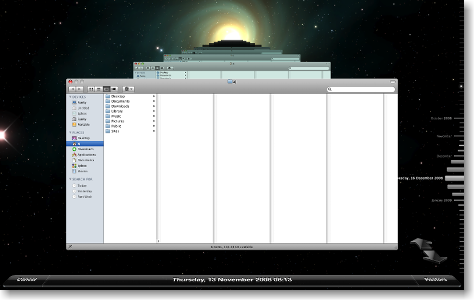 I’ve had a couple of articles open to remind me to blog about them for a while now – one from Tim Bray’s Android Diary and a response to it from Nick Kew. The key part of Tim’s post:
At a deep level, debugging with print statements is superior to all other approaches. Which is good, because we seem to be stuck with it. Firstly, I’m very strongly against debugging via System.err.println – you should have a logging system in place instead and just add extra messages to that. That way if you accidentally check them in, at least they go to the logs and are hidden at DEBUG level rather than annoying everyone all the time by going to System.err.
Embrace Your Inner Deletionist
One of the popular geek pissing contests is comparing how far back your email archives go. It’s a game I’ve enjoyed playing in the past and quite regularly one given that I’d never deleted an email (ahh the days before spam…). Still, as Andy has just discovered, it’s not always as useful as it first seems:
I have to say though I’m not sure keeping all of this email was the best idea. I’ve glanced at a few old emails while sorting this evening and… well put it this way, would you want a detailed account of your uni years? If your email is just building up without requiring any effort on your part then there’s no real advantage to deleting it and it may as well sit there. Once you come to expend time and effort migrating that email though it just becomes a waste of your time. The trouble is, now that you’ve got all that email, you’ve got no idea which bits are important to keep and which aren’t. You’re stuck on the treadmill of migrations until it eventually gets so time consuming that you figure it’s easier to just dump everything and start again.
When Did I Become a Writer?
It occurs to me that for the past two years I’ve written at least one post a week (not as much here, mostly over there). In the next week or two I’ll be spending most of my time writing demo scripts, white papers, various other technical documentation and a couple of speeches. I’m pretty sure if I counted it all up I’d have written way more English than I have Java or any other programming language. That’s not even counting email, which I’ve been writing tons more of.
MSIE Users Will Be Laid Off
Shelley Powers on Burning Bird’s RealTech:
We’ll see a significant reduction in MSIE corporate users, as many will get laid off. Fair cop…
LiveWorks! is Dead – Long Live LiveWorks!
With LiveWorks! turning two it’s gone through a major stage of growing up and now sports the official Ephox website look rather than it’s more youthful green tinge. The different look was originally put in place because LiveWorks! was designed to hold a bunch of unofficial, unsupported, experimental stuff – most of which is still there but has gradually become more supported and much less scary to use in actual production systems. In the mean time, we’ve added a ton of new, really useful, very much supported (i.e. used as answers to support questions) content which we want users to find and use.
The Secret to Improving Documentation
Believe it or not, it’s been almost exactly 2 years since I kicked off LiveWorks! as essentially a skunk-works project to get some of our internal experiments out into the open so they proved useful. As it turns out the bigger success has been the weekly hints and tips that we started adding a few months later. Unless one of the migrations has messed up the dates, the first tip was a simple overview of how to integrate EditLive! that Rob wrote. I still regularly refer people to that article. Since then we’ve posted a new article every single week without fail.
A Common Fallacy
Geir turns out to be the latest in a very long and prestigious line of folk to bring up a rather common fallacy that I find amusing:
I’d love to see a common UI for things like this, just like cars have a common UI for the basics Cars do have some things that are very much similar – they have a steering wheel and at least an accelerator and brake. That’s good and while you could define that as the basics as Geir was probably thinking, that’s about the same complexity as turning on a computer and maybe opening a program or two.
On Design, Learning and Self-Improvement
Dylan posted a good blog post at a ridiculous time of night last night discussing software architecture, his role in it and more. Firstly, it’s really good to see these kinds of blog posts appearing – Ephox has gotten really slack at blogging and I think that’s a shame because we have a lot of good stuff to say. Actually publishing things makes you actually think it through and it allows people to build on those ideas and improve them. It’s always hard to find the time and energy to blog, but it’s worth it.